
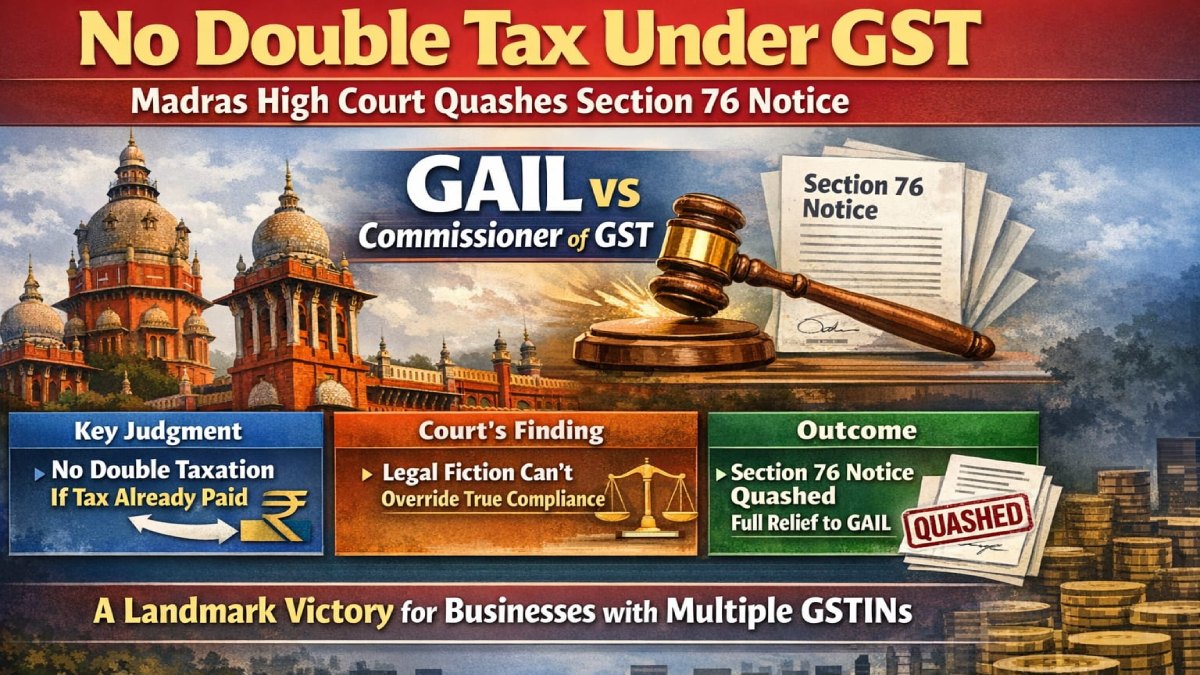
Madras High Court in a landmark decision has affirmed a fundamental principle of GST law: tax cannot be demanded twice if it has already been paid. The judgment has played a pivotal role for businesses with multiple GST registrations and the Gas Authority of India Limited. Commissioner verdict offers much relief.
The Core Issue
GAIL has two business verticals, namely transmission and trading, and each has its own GST registration. A show cause notice was served by the tax department under Section 76 of the CGST Act claiming that the trading division collected tax from clients and failed to remit it. But GAIL proved that the total amount of tax had already been paid to the government through its transmission division. The dispute did not pertain to non-payment but to which GST registration had made the payment.
Court’s Key Findings
The Court indicated that Section 76 does not apply in cases where tax is collected but has already been paid. Because the tax had already reached the government, invoking this provision was invalid. The Court also explained that although GST law considers multiple registrations as “distinct persons” under Section 25(4), that is a mere legal fiction. This concept cannot outweigh true compliance, particularly without a loss to revenue.

No Double Taxation
The judgment reinforced that tax on the same transaction could not be imposed twice by authorities because of separate GST registrations. Double taxation which is not allowed would arise.
Outcome
The show cause notice under Section 76 was quashed, thereby granting full relief to GAIL.
Why This Matters
This ruling is a huge windfall for businesses that have several GSTINs under one PAN. It verifies that GST compliance should be judged by substance, not technical structure. Additional proceedings on the basis of Section 76 cannot be continued as long as the government has already received the tax and there is no revenue loss. The decision establishes a crucial precedent and a pragmatic, sensible way to handle GST enforcement in India.








Comments