While artificial intelligence, Neuralink, and 6G networks take the headlines, there is an engineering discipline that is quietly making these innovations possible Signals & Systems.
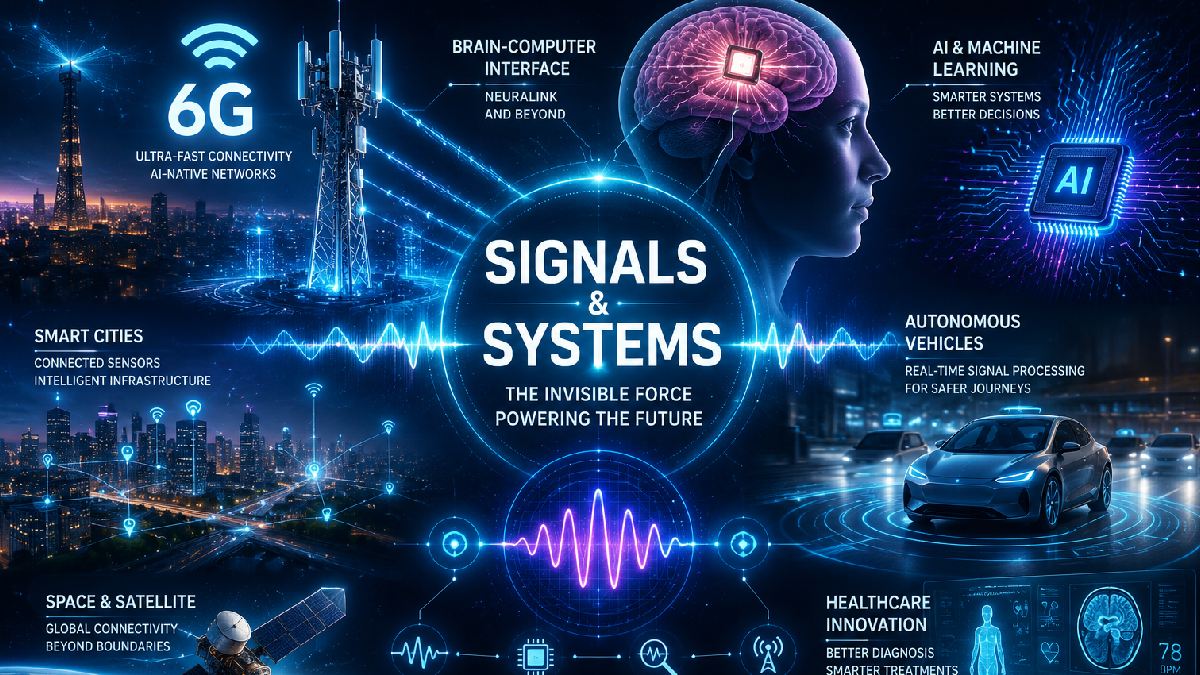
As one of the toughest engineering subjects, Signals & Systems is the backbone of today’s communication, computing, healthcare, robotics, and space technology.
Every smartphone call, wearable health monitor, satellite transmission, and AI-based application depends on the ability to capture, process, and interpret signals accurately.
The transition from 5G to 6G will bring data speed and latency down very fast and introduce AI-native communication networks. These need advanced signal processing to handle huge amounts of wireless data while minimizing interference and improving network reliability.
Another rapidly emerging area is brain-computer interfaces. Neural implant technology is being developed by companies that will be able to read electrical signals from the human brain.

These signals are very weak and need to be filtered and processed to translate them into computer commands. Such technologies could eventually enable paralyzed people to communicate or control assistive devices via their thoughts.
Healthcare is also being helped by the advances in signal processing. Wearable devices monitor heart rate, blood oxygen levels, sleep patterns, and other health indicators continuously. Hospitals are increasingly using AI-assisted medical imaging, ECG interpretation, and diagnostic systems that use accurate signal analysis.
Autonomous cars are another example. Self-driving cars combine the information from cameras, radar, LiDAR, GPS, and ultrasonic sensors, and signal processing algorithms are used to combine the information with the surrounding environment for a more accurate sense of the vehicle in order to be able to navigate safely.
But another big growing application is that of space technology. Satellite internet networks, deep-space communication, and future lunar missions depend on efficient signal transmission across vast distances with minimal interference and data loss.
Quantum communication is also being studied by researchers in the field of highly secure data transmission. Despite their different physical principles, these systems need sophisticated signal detection methods to detect extremely weak optical signals.
As smart cities continue to grow, billions of connected sensors will monitor traffic, pollution, energy usage, transportation, and public safety. Managing this huge amount of information in real-time will require more sophisticated signal processing techniques.
Industry experts believe future engineers will need knowledge in Digital Signal Processing (DSP), artificial intelligence, embedded systems, robotics, wireless communication, and IoT. AI is not replacing Signals & Systems, but it is complemented by them.
Though it rarely gets much public attention, Signals & Systems is quietly becoming one of the most important technologies behind the next generation of innovations, connecting people, machines, and intelligent systems in ways that were once seen as science fiction.