
Expanding its Gemini family of artificial intelligence models, Google has announced Gemini 4 Carbon, a new frontier AI model designed to advance software coding, complex engineering and cybersecurity defence. The launch comes around two weeks after the company introduced Gemini 4 Argon, as Google continues to compete with OpenAI and Anthropic in the race to develop more capable AI systems.
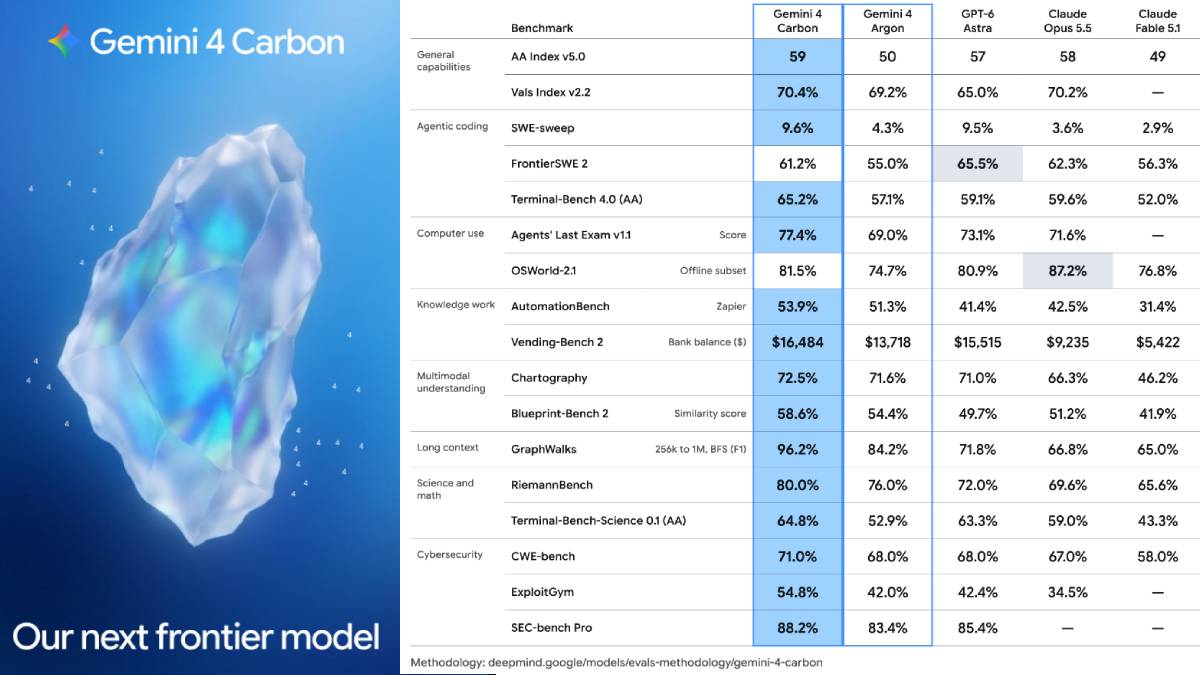
In its official announcement on Oct 28, Google described Carbon as “our strongest model with state-of-the-art cybersecurity and long horizon capabilities.” The company says the model is designed to handle complex, multi-step engineering tasks that can require sustained reasoning and work across large codebases.
Gemini 4 Carbon is intended to help developers and cybersecurity professionals identify software vulnerabilities, assess potential security risks and develop patches. According to Google, the model can work through complicated engineering problems over extended periods, including tracking down subtle bugs and addressing their underlying causes rather than simply correcting surface-level errors.
The company reported that Carbon achieved strong results across several cybersecurity benchmarks. It scored 88.2% on SEC-bench Pro, which evaluates the discovery of software vulnerabilities, and 54.8% on ExploitGym, which assesses vulnerability exploitation capabilities. It also achieved 71% on CWE-bench, a benchmark focused on fixing software vulnerabilities.
Google further said that Carbon achieved more than twice the success rate of Gemini 4 Argon in generating secure code on its internal benchmarks. These results suggest that the new model could help security teams identify and address software weaknesses more efficiently, although independent testing and real-world deployment will be important in assessing its practical performance.
The model is also designed to support longer-running software engineering workflows. Google said its internal teams had seen Carbon work for days on complex tasks, persisting through dead ends while attempting to diagnose and fix difficult problems across large codebases and low-level systems.
However, the model’s capabilities also raise concerns about the potential misuse of advanced AI for cyberattacks. Systems that can identify vulnerabilities and reason through exploitation techniques could potentially be misused by malicious actors if adequate safeguards are not in place.
To address these concerns, Google is taking a phased approach to the rollout. The company said it would initially make Gemini 4 Carbon available to a subset of trusted cybersecurity defenders through its Fairwind Program. Access will gradually expand to additional trusted partners as Google gathers feedback, evaluates safety measures and improves the model’s safeguards.
The Fairwind Program was established to provide selected government agencies, critical-infrastructure operators and cybersecurity partners with advanced AI tools to identify and address digital security risks. Google says the programme is intended to help defenders proactively detect vulnerabilities and protect essential systems, public services and national security.
The company is also participating in a voluntary US government process for pre-release model testing. Google has said it intends to expand Carbon’s availability to developers, businesses and consumers through its products as soon as possible, while continuing to assess the model’s safety and reliability.
Gemini 4 Carbon will launch at an introductory price of $2 per million input tokens and $10 per million output tokens, matching the introductory pricing of Gemini 4 Argon. Cached input tokens will receive a 95% discount compared with the standard input-token price.
The introductory rates are temporary. Google’s published pricing for Argon specifies that, after November 30, 2026, standard pricing will rise to $4 per million input tokens and $20 per million output tokens. Carbon’s announced introductory pricing matches Argon’s, although developers should check the applicable Carbon pricing terms when accessing the model.
The launch also highlights Google’s continuing efforts to strengthen its position in the AI industry. With OpenAI and Anthropic competing to build increasingly capable models for software development, business applications and advanced reasoning, improvements in coding and cybersecurity have become an important part of the broader competition.
Google has spent years integrating AI into its products, infrastructure and research, and Carbon represents another step in that strategy. The challenge now is to ensure that increasingly powerful systems can help developers and cybersecurity teams solve difficult problems without creating new risks for the digital infrastructure they are intended to protect.
After the announcements, many users have shown dissatisfaction with the situation, some complaining that Google should not make claims of launching products if it will not be available to the general public, while many others said that this feels redundant, as Google had just released its previous product in the same field just 2 weeks ago, making people wonder if this is just a move to hype up stocks and further expand an alleged AI bubble.
While many said that they await the "cycle" to complete, with Anthropic releasing a stronger product in the future and getting ahead in this Race.






Comments