
Global warming and changing weather patterns have emerged as major environmental problems for the world. Melting polar ice caps, rising ocean temperatures, and rising and sea levels rising are threatening islands and coastal cities around the world countries like Maldives, Tuvalu, Kiribati and Marshall Islands are increasingly worried about coastal flooding, land erosion and loss of habitable land; Mumbai, Chennai, Kerala and Sundarbans in India are also coastal regions where consequences of rising seas and extreme weather events will come to pass.
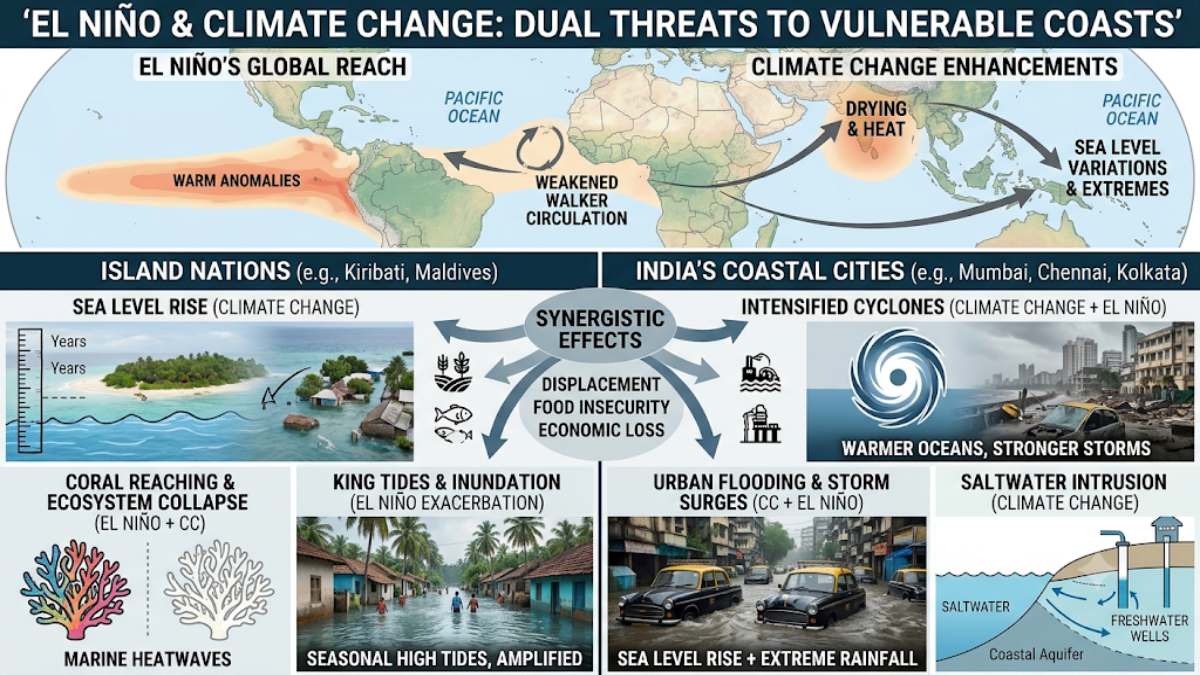
Climate change is responsible for long-term rise in global sea levels, but El Niño can affect ocean conditions, rainfall patterns and regional weather risks too.
El Niño is a naturally occurring climate phenomenon that occurs when sea surface temperatures in the central and eastern equatorial Pacific Ocean are unusually warm. It belongs to the El Niño-Southern Oscillation (ENSO), which includes El Niño, La Niña and neutral conditions.
Climate change refers to long-term changes in global temperatures and weather patterns caused by human activities (burning of fossil fuels, deforestation, etc.). El Niño and climate change are separate phenomena, but together they increase the risk of heatwaves, droughts, heavy rainfall and other extreme weather events.
What Are the Major Causes of Sea Level Rise?
Sea levels are rising mostly because of two main reasons: melting land ice and thermal expansion of seawater. As global temperatures rise, glaciers and ice sheets in Greenland and Antarctica melt more water is added to the oceans. This is a major contributor to long-term sea level rise.
The second is the expansion of ocean water with rising temperatures. When seawater gets warmer, it expands and takes up more space, so thermal expansion (or expansion due to heat) increases sea levels even without additional water entering the ocean.
Other local factors can amplify the effects of rising seas. Waves and storms erode land along shorelines over time. Land subsidence (when ground sinks due to natural processes or too much groundwater extraction) can also raise relative sea level in some places. So some coastal regions experience sea level rise at rates much higher than the global average.
Island Nations Facing the Greatest Threat
Maldives: The Maldives (Indian Ocean) is one of the world’s most vulnerable island nations. Many of its islands are only a few metres above sea level. Rising seas could affect residential areas, tourism infrastructure, airports, freshwater resources saltwater intrusion into groundwater supplies too.
Tuvalu: This Pacific island nation is very low-lying, so sea level rise will reduce habitable land, increase coastal flooding and damage infrastructure. Saltwater entering freshwater sources and agricultural land could be further problems for local communities.
Kiribati: Kiribati is particularly vulnerable to coastal erosion, flooding and saltwater intrusion. Its low-lying atolls are under increasing pressure from rising seas (housing, food production, access to freshwater).
Marshall Islands: The Marshall Islands are made up of low-lying coral atolls that are subject to ocean waves, coastal flooding and erosion. Rising sea levels could threaten infrastructure and the long-term habitability of several islands.
Fiji and Samoa: Coastal communities in these Pacific countries could see increased flooding, erosion and damage from storm surges. Some vulnerable settlements may need relocation to safer ground eventually.
El Niño: Which Countries Could Be More Vulnerable to Climate Risks?
El Niño can have global effects on weather patterns by changing ocean temperatures and atmospheric circulation. Its effect depends on how strong the event is, what season it is and local climate conditions.
India could see changes in monsoon rainfall, with weaker rain during some El Niño events possible. Reduced rainfall affects agriculture, water availability and rural livelihoods, but El Niño doesn’t mean drought for India.
Indonesia could see less rainfall, drought conditions and more forest fires. Australia could have hotter, drier conditions in some places, increasing the risk of drought and bushfires.
South Africa and Zimbabwe could have rainfall shortages and agricultural losses during some El Niño events, while Peru and Ecuador might see heavy rainfall, flooding and landslides (particularly along the Pacific coast).
Parts of Central America may experience drought and declining agricultural production. In some parts of the southern U.S., El Niño can affect winter rainfall and storm patterns.
The effect of El Niño is not the same everywhere in the world. It depends on regional weather systems, ocean conditions and other climate influences as well.
How Rising Sea Levels Could Affect India
India has a coastline of about 7,500 kilometres (including its island territories). Millions of people depend on coastal ecosystems, fishing, tourism, ports and maritime trade for their livelihoods. Sea level rise could pose economic and environmental challenges.
Mumbai, Maharashtra: Rising sea levels with heavy rainfall and high tides could increase flooding risks in low-lying areas. Urban infrastructure (roads, railway networks, etc.), residential buildings and other buildings would be more exposed to coastal flooding.
Chennai, Tamil Nadu: Coastal erosion, saltwater intrusion and flooding could impact residential areas and infrastructure. Sea level rise may also magnify the effects of extreme rainfall and storm surges.
Sundarbans, West Bengal: The Sundarbans region is threatened by rising sea levels, coastal erosion and cyclones. Mangrove ecosystems, agricultural land and livelihoods could be affected.
Odisha Coast: Coastal districts of Odisha are prone to cyclones, storm surges and flooding. Sea level rise could increase damage caused by severe coastal weather events.
Kerala Coast: Coastal erosion, stronger waves and flooding could impact homes, fishing communities and coastal infrastructure. Several areas along the Kerala coast already have shoreline erosion.
Five Major Challenges India Could Face
Climate change, sea level rise and changing weather patterns could all pose challenges for India.
Agriculture could be affected if El Niño reduces monsoon rainfall. Water shortages may put more pressure on reservoirs, groundwater and drinking water supplies. Fishing communities might see changes in fish distribution because of warming oceans and altered marine ecosystems.
Coastal flooding and saltwater intrusion could damage homes, roads, agricultural land and freshwater supplies. Economic losses might also occur in tourism, ports, transportation and coastal industries.
These risks reinforce the need for climate adaptation planning and disaster preparedness across vulnerable regions.
What Is the Connection Between El Niño and Sea Level Rise?
El Niño can cause temporary changes in regional sea levels because it affects ocean circulation and rainfall distribution. When El Niño occurs, rainfall patterns change across the Pacific, so water that would otherwise be stored on land is redistributed into the ocean (sea level).
However, El Niño is not the main driver of long-term global sea level rise. The main drivers are still warming and expansion of seawater and melting of land-based glaciers and ice sheets.
This is important because El Niño-related sea level changes occur over shorter time periods (weeks, months), whereas climate change-driven sea level rise continues over decades/centuries.
Strong El Niño Forecast Raises Global Climate Concerns
NOAA issued an El Niño advisory in October 2026 that the phenomenon was strengthening. NOAA’s Climate Prediction Centre said a strong-to-very-strong El Niño was likely to continue through January–March 2027 and “there is increased likelihood of significant climate impacts”.
The WMO also warned in September 2026 that the strengthening El Niño could affect global rainfall and temperature patterns, increasing risks of extreme heat, drought and flooding.
Meanwhile, a Commonwealth report published on 21 October 2026 showed how vulnerable some island nations were to sea level rise. Sea level rise rates near Tuvalu and Kiribati were estimated at 5 mm per year; Tonga had around 7.3 mm per year since 1993, much faster than the global average, but local geography still matters.
Can the Risks of Climate Change and Sea Level Rise Be Reduced?
Governments and communities can take several steps to reduce risks from rising seas and extreme weather. Reducing greenhouse gas emissions through renewable energy sources (solar and wind power) is key to limiting long-term global warming.
Protecting mangrove forests and coastal ecosystems can reduce erosion and provide natural protection against waves and storm surges. Governments can improve drainage systems along the coast, build protective barriers where necessary and strengthen early warning systems for floods and cyclones.
Vulnerable communities need climate-resilient infrastructure, disaster preparedness programmes and carefully planned relocation (where necessary). Sea level monitoring and climate conditions should also be monitored continuously.
The threat of sea level rise is another reason for global cooperation. El Niño is a natural climate event, but long-term climate change makes the risks faced by vulnerable island nations and coastal communities greater. Scientific monitoring, sustainable development and effective adaptation measures will be crucial in protecting people, infrastructure and ecosystems in the coming decades.





Comments