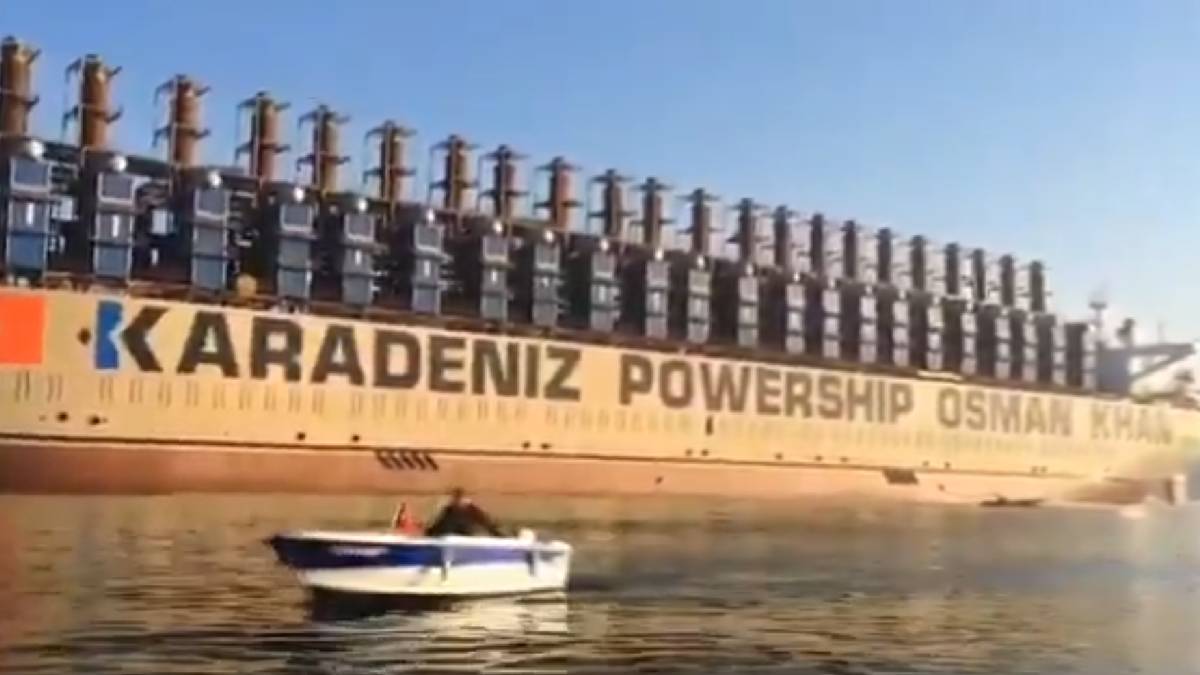
A powerful piece of energy infrastructure on the coast of Ghana that looks more like a cargo vessel than a power station lies far offshore. The MV Karadeniz Powership Osman Khan, a 299-metre-long floating power plant, has been providing electricity to Ghana since 2017 and can generate as much as 480 MW of power.
The ship is part of a worldwide trend in which ships that are customised to be mobile or floating power plants are also being used as mobile power plants. Rather than building a conventional power station on land, the vessels can generate electricity offshore and bring it to a country’s electricity grid via specific infrastructure.
The size of the ship is one of its most striking features. At almost 300 metres long, the Osman Khan is in fact large compared to many of the world’s biggest commercial ships. But it’s not delivering anything to or from passengers. It’s an electricity-generating floating facility.
The capacity of up to 480 MW is large. At certain levels of demand and depending on the country's overall generation mix, that will be a large part of Ghana's electricity supply. The ship has thus been instrumental in developing the country's power-generation capacity since it started operation in 2017.
A single ship anchored off Ghana's coast generates about 12% of the country's electricity.
— Massimo (@Rainmaker1973) August 19, 2026
The MV Karadeniz Powership Osman Khan is 299 meters long and pumps out up to 480 MW of power.
It has been doing this since 2017. pic.twitter.com/7ebTR2YfeG
Floating power plants can have a few advantages for countries that want to produce electricity soon. Construction of a large conventional power station takes years of planning and construction and infrastructure development. On the other hand, a power-generating vessel that could be deployed to a place where the grid and port infrastructure could already be in place for a power plant could be built.
A more useful concept for countries with electricity shortages or looking for more generating capacity while more long-term energy projects are being developed.
The Osman Khan is based on the Karpowership model, where converted or purpose-built vessels produce electricity and transfer it to national grids. The approach has been adopted in many countries, and floating power ships are growing in importance in the international energy market.
Ghana has been struggling to produce reliable electricity, and generation capacity, fuel availability and demand are all factors that affect the country's power supply. Even more electricity has been supplied from floating power plants.
The ship’s capacity to produce hundreds of megawatts from an offshore location also demonstrates the scale at which maritime infrastructure can be integrated with national energy networks. Electricity generated aboard the ship is transported to shore to be fed into Ghana’s grid for use by homes, businesses and industries.
The technology behind such ships is marine engineering and power generation equipment. Inside the ship, there are generators and supporting systems to convert fuel into electricity. The vessel needs to meet the operational requirements of a power plant as well as a large marine ship.
In addition to Ghana, floating power plants have been developed or proposed in many other countries in the world in the last few years, especially in countries where a flexible electricity generation option is required. Their mobility has an advantage over fixed infrastructure because they can theoretically be moved if energy needs change.
But the model also raises questions about fuel costs, emissions and long-term energy security. Most conventional powerships rely on fossil fuels or gas-based generation, and so most environmental impact comes from fuel consumption and the efficiency of generating units.
As more countries move toward renewable energy, floating power plants may well be complementary sources of electricity during times when renewable generation is insufficient. At the same time, governments need to balance reliability of electricity with decarbonisation targets for the future.
The MV Karadeniz Powership Osman Khan is a great example of how a ship can play an important role in a country’s electricity system. Since 2017, the vessel has shown how offshore generation can provide a lot of power without needing a conventional power station to occupy a large area of land.
A nearly 300-metre ship anchored offshore producing up to 480 MW may sound futuristic, but it is a practical engineering solution already being used in Ghana.
The story of the vessel is emblematic of the ever more complex energy landscape in which electricity can come not only from conventional power stations, dams and solar farms, but also from giant floating facilities anchored at sea and directly connected to national grids.