A new development in humanoid robotics is catching attention for a rather unusual feature: the robot can automatically head back to its carrying case and fold itself into it, allowing it to be stored and transported without a human having to manually disassemble or reposition the robot.
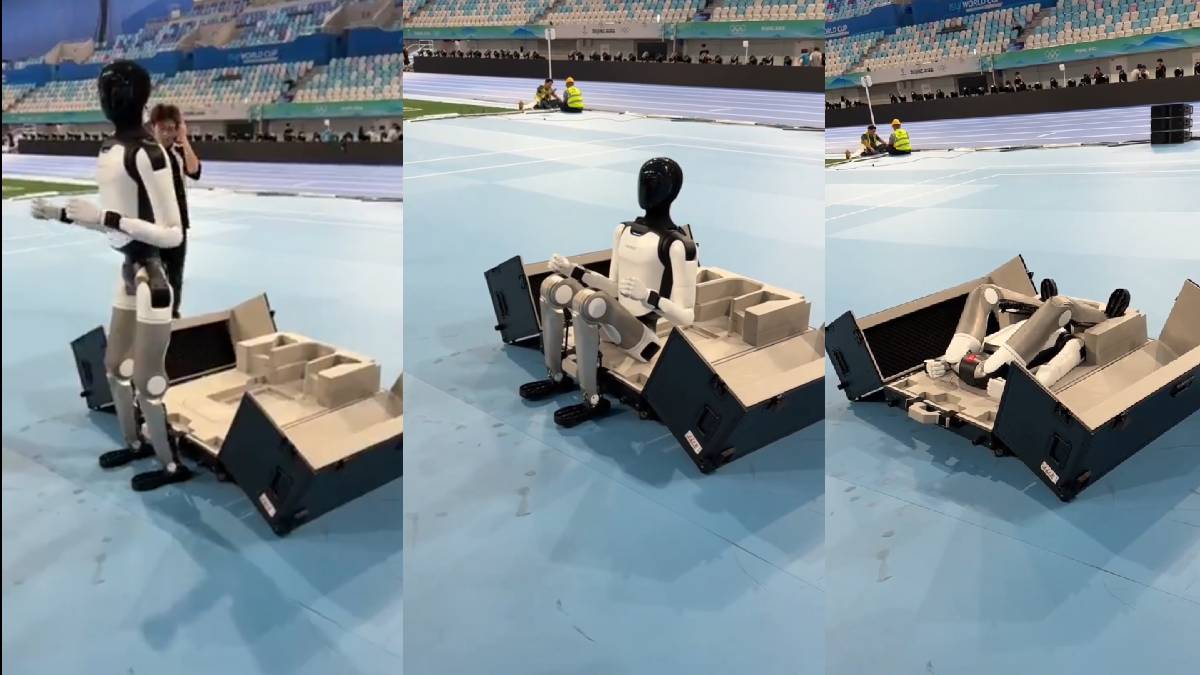
The concept emphasizes how robotics is moving beyond simply teaching machines to walk, manipulate objects and interact with their environment. Engineers are also looking at ways to make robots easier to transport, deploy and store: humanoid machines are increasingly sophisticated and even more prevalent in the workplace and homes.
The self-stowing capability allows the humanoid robot to move from an upright position into a compact configuration. Once ordered to come back to its case, the robot can move towards the container and fold its body and limbs into the available space.
This relatively simple feature could have practical implications. Humanoid robots are designed with human-like proportions, which makes them useful for environments built around people but can also create challenges when the machines need to be moved. A robot that folds into an individual carrying case could make transportation much easier.
A compact carrying case, instead of having to move the robot inside a big vehicle or specialized equipment, could enable the machine to be quickly carried out. The robot could then unfold and be put back into production once it arrives at its destination.
✨🇨🇳The humanoid robot can stow itself away by automatically returning to its carrying case and folding itself into it. pic.twitter.com/JHhGbeqVTa
— 🇨🇳XuZhenqing徐祯卿 (@XueJia24682) August 20, 2026
The technology also demonstrates the importance of precise autonomous movement. For a robot to put itself in a case, the software and hardware must coordinate multiple movements. The robot needs to understand its position relative to the case and carefully control its arms, legs, and torso while folding.
Such movements require mechanical engineering, sensors, motion planning, and control systems. Even a small positioning error could potentially prevent the robot from fitting properly in the container.
The self-stowing design could be particularly useful for robots that are meant for commercial or industrial purposes. Robots deployed in humanoid robot-based systems from across the world would be able to prepare themselves for transportation without requiring much human involvement.
It could be useful in research projects during exhibitions and demonstrations as robots generally need to be transported between locations.
One interesting aspect of this is the idea that a robot has a "home" or storage setup. In doing so, the carrying case is integrated into the robot's operating ecosystem and not just a simple storage container, as it allows the robot to return to the case after completing the task and be stored safely until it is needed again.
As the humanoid robot continues to evolve, portability will become increasingly important. Heavy robots are difficult to move because of their weight, size and mechanical complexity. Folding mechanisms may be one solution that reduces the machine's physical footprint when it is not in use.
The development also demonstrates how robotic design is increasingly focused on convenience in addition to capability. Walking, balancing and object manipulation remain major technical challenges, but practical features such as transportation, charging and storage will also shape whether humanoid robots can be adopted widely.
A self-stowing robot could eventually provide a more streamlined experience: arrive at a location, unfold, perform its assigned tasks and return to its case when finished.
While the technology is still in the rapidly developing robotics space, the ability to automatically fold into a carrying case shows the creative engineering methods being explored to make humanoid robots more practical.
The image of a full-sized humanoid robot calmly walking back to its case and folding itself away may look futuristic, but it is representative of a much broader robotics trend that is emerging—machines that are designed to not only perform autonomous tasks but also to manage aspects of their own transportation and storage.