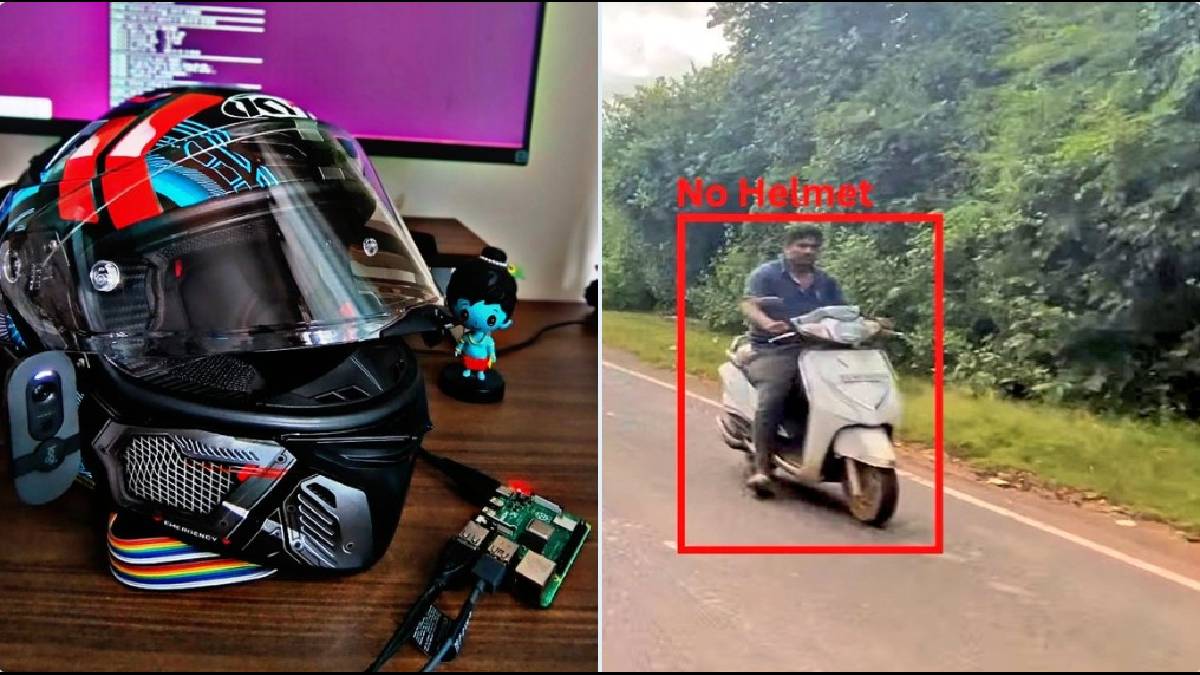
Solutions have always been about the same old, the everyday challenges that lead to invention, and that is the story of one Bengaluru software engineer, a role model of how a machine should solve civic issues. A model of road law enforcement that does live data collection to detect traffic offenses was created to follow. Using an AI-driven traffic police tool, he turned an ordinary helmet into one with real-time, on-the-spot traffic enforcement capabilities. Apart from pinpointing the violation of rules, the helmet captures proof, including locations and number plates, and sends it to police directly. This creative invention, which brought the spotlight across India, reveals how AI can be put at the service of traffic safety and accountability.
The Idea Behind the Helmet:
Indian cities get hit with traffic violations daily. From jumping signals to going without helmets, one person breaking rules has become commonplace for many people. Feeling bad about the discipline problems on the streets but also the general lack of respectability and lack of discipline on the roadways, the engineer took to software and AI he hoped to create a road engineering solution. His idea is plain and powerful: make a device that would be similar to a traffic police car, only it will not need humans. But he then installed AI on a helmet that allows him to use it as a safety system to monitor violations wherever he goes.
When does the helmet work?
This helmet is fitted with cameras and sensors which constantly scan the surroundings. Using AI algorithms it can pick up on breaches such as signal jump, triple riding, driving without helmets or those other sorts of behavior like this. When a violation is discovered, the system takes an image or video, tags it with the exact location using a GPS unit and identifies the vehicle’s number plate. This data is subsequently transmitted directly to the police database in real time. The police have proof of the offense and all details needed, and therefore can fines or take measures accordingly. It's automated, thereby minimizing the need for human monitoring and preventing offenders from escaping blame.
Benefits of the Smart Helmet:
This invention has many advantages. First, it allows police to monitor the traffic more efficiently without visiting each junction physically. The second way this leads to an atmosphere of fear among its violators is through a sense that they can be apprehended anytime and anywhere. Third, it limits corruption by collecting digital proof that is forwarded directly to authorities. For a city's citizens the helmet is a step toward safer roads. With better enforcement accidents due to reckless driving can be reduced. In addition it also illustrates how individuals can contribute to solving the world's problems of civilization by innovating itself.
Public Reaction:
News of the new smart helmet has gone viral, with lots of people extolling the engineer’s creativity. It has been described as a “game-changer” and “the future of traffic policing” on social media. Some even recommend that such helmets be given to volunteers, or to traffic wardens, on the city’s sidewalks. Simultaneously, issues involving privacy and data security are being debated. Because the helmet images are taken and sent to police authorities, some are concerned about the use of data. If the tech is monitored and protected like this, most experts believe it can solve such concerns and continue to reap the benefits of the technology, experts said.
The Bigger Picture:
This invention fits into a broad trend in which AI is bringing about the sort of meaningful results we seek from it. From smart cameras to automation, tech is increasingly being used to solve problems in civic management areas. The Bengaluru engineer’s helmet embodies how grassroots innovation can supplement official effort. If that widespread implementation proves successful, such devices would revolutionise traffic control in India. Cities could rely on AI-powered tools to monitor roads 24/7, instead of just humans working to police them. This would help to standardize police enforcement and ease the burden for authorities.
The brainchild of a Bengaluru software engineer, the intelligent smart helmet isn't just a "friend" gadget, but a vision of how technology can make cities safer and more structured. The helmet connects innovation and responsibility by actively detecting violations and instantly sending evidence straight to police. It serves as a model for how people can be empowered with their skills to solve our common challenges. This invention looks forward to a future where the law is obeyed and traffic is a crime free world in a nation where road traffic is common and the safety and effectiveness of technology intertwine with how we run our country.