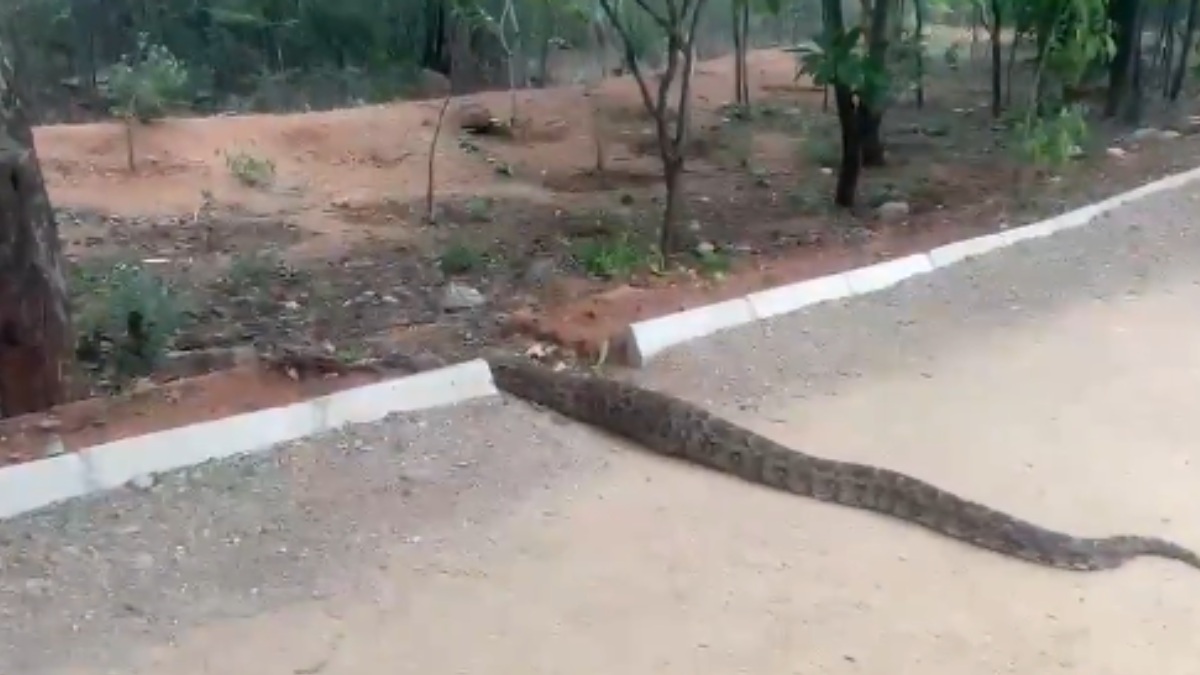
Visitors to Kasu Brahmananda Reddy (KBR) National Park in Hyderabad’s Banjara Hills were met with a very unusual sight on Saturday morning when a giant python about 20 feet in length was seen in the park. The sight caught the attention of morning walkers, fitness lovers, and wildlife lovers, and a lot of them took photos and videos from a safe distance.
The huge snake soon became part of the conversation on social media, with photos and videos of the python circulating widely. Many people marveled at the size of the snake, but also at the biodiversity in one of Hyderabad’s most prominent urban forest parks.
Witnesses said the python was seen moving slowly through a vegetated area of the park early in the morning. Park officials and forest officials were on the scene right away to check it out and to intervene so as not to endanger the people.
Forest workers monitored the reptile's movements and told visitors to stay calm and keep a safe distance. Pythons are generally non-venomous snakes and don't approach humans unless they are threatened or cornered, the officials said. A few parts of the park were monitored as a precautionary measure until the reptile moved away from areas frequented by visitors.
KBR National Park, one of Hyderabad's most important urban green spaces, is home to a vast array of flora and fauna. Although it is surrounded by bustling residential and commercial neighborhoods, the park has many birds, reptiles, insects, butterflies, and small mammals. Wildlife experts note that sightings of reptiles (including snakes) are a natural part of the ecosystem, but that extremely large pythons are relatively rare.

Indian rock pythons are protected under the Wild Life (Protection) Act, 1972, and are instrumental in maintaining ecological balance by naturally controlling populations of rodents and other small animals. Being non-venomous constrictors, they rely on their strength rather than venom to capture prey. Wildlife experts insist that these reptiles avoid human interaction whenever possible.
The sighting has also served as an important reminder that urban forests are living ecosystems where humans share space with wildlife. As cities expand, protected green spaces like KBR National Park become more and more important refuges for native species. To sustain biodiversity and to allow people to experience nature in urban environments, these habitats need to be maintained.
Forest officials have advised people not to be alarmed if they see wildlife in protected areas of the forest. They recommend maintaining a safe distance, refraining from attempting to photograph animals too closely, avoiding sudden movements, and immediately informing park authorities. Disturbing or provoking wild animals can increase risks for both humans and wildlife.
Wildlife conservationists welcomed the sighting as evidence of a healthy ecosystem. Apex reptiles like pythons typically indicate sufficient prey availability and a relatively stable environment. Conservation experts believe that urban forests need to be protected in order to maintain this biodiversity.
Viral videos posted online have generated widespread curiosity about pythons and their behavior. But experts say that when estimating the size of an animal from photos or videos, camera angles and perspective can be misleading. Forest officials will be able to observe and monitor wildlife behavior in and around the park as part of routine conservation efforts.
Hyderabad has had occasional sightings of snakes in residential areas next to forested areas during the monsoon season when snakes are more active and may venture into the areas in search of food or shelter. Wildlife authorities regularly advise residents not to harm snakes and to contact trained rescue personnel if a reptile enters a residential area.
Environmentalists say that such sightings can provide valuable opportunities for public education about wildlife conservation. The awareness campaigns conducted by forest departments and wildlife organizations emphasize the ecological value of species like pythons and promote coexistence between people and nature.
A giant 20-foot #python was spotted inside #KBRNationalPark in #Hyderabad's #BanjaraHills on Saturday morning, surprising #walkers during their regular stroll.
— NewsMeter (@NewsMeter_In) July 18, 2026
The massive #reptile took several minutes to slowly cross one of the park's #walkingtracks, leaving many #visitors… pic.twitter.com/7aWbmuOMb6
As news of the giant python spread across Hyderabad, many nature lovers viewed the sighting as an indicator of the richness of nature in the city's green spaces. The reptile's appearance might have caught the eye of early morning walkers, but officials reiterated that the situation remained under control and urged everyone to respect wildlife by allowing animals to remain undisturbed in their natural habitat.
The incident has once again highlighted the need for urban forests like KBR National Park, where wildlife continues to thrive despite rapid urbanization. If people and wildlife are respectful to the environment and conservation is maintained, then such protected areas can still be safe havens for both people and native wildlife.